

Gene therapy dramatically cuts risk of bleeding in haemophilia B patients
A single gene therapy injection could dramatically reduce the haemorrhage hazard faced by people with haemophilia B, finds a study involving UCL researchers.
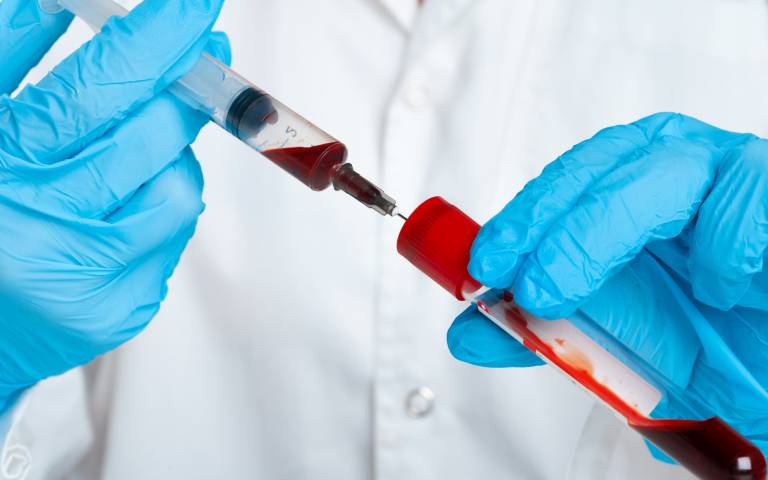
For the paper, published in the New England Journal of Medicine, experts from UCL, Majestic Free Hospital and biotechnology company Freeline Therapeutics trialled and go along to evaluate a new blazon of adeno-associated virus (AAV) gene therapy candidate, called FLT180a, to treat severe and moderately astringent cases of the condition.
Haemophilia B is a rare and inherited genetic haemorrhage disorder caused by low levels of the factor IX (Prepare) protein, needed for forming claret clots that aid preclude or stop bleeding. The gene responsible for making FIX poly peptide is located on the X chromosome, and then the astringent form of haemophilia B is much more mutual in men.
Currently, patients with haemophilia B need to inject themselves regularly – usually weekly – with recombinant FIX, i.east. regular replacement therapy to preclude excessive bleeding. Despite advances in treatment, patients may continue to see debilitating joint damage.
The Phase I/2 multi-centre clinical trial, called B-Astonish, and the related long-term follow upward study found that one-time treatment with FLT180a led to sustained production of Set up protein from the liver in nine of ten patients, across iv different dose levels, removing the need for regular replacement therapy.
Out of 17 male patients aged xviii or over who underwent screening, 10 with severe or moderately astringent haemophilia B took office in the 26-week trial of FLT180a. They are besides all enrolled in the long-term follow up study to assess prophylactic and durability of FIX expression for 15 years.
Atomic number 82 author Professor Pratima Chowdary (Royal Free Hospital, UCL Cancer Plant) said: "Removing the need for haemophilia patients to regularly inject themselves with the missing protein is an important step in improving their quality of life. The long term follow upward study will monitor the patients for immovability of expression and surveillance for late effects."
AAV gene therapy works past using a packaging from the proteins establish in the outer coat of the virus, to evangelize a functional copy of a gene directly to patient tissues to compensate for ane that is not working properly. Newly synthesised proteins are released into the blood and a one-time infusion can reach long-lasting effects.
Patients needed to take immune suppressing drugs over several weeks to several months, to prevent their immune systems from rejecting the therapy, and all reported known side furnishings.
While the treatment was more often than not well tolerated, all patients experienced some form of adverse events, with an abnormal blood clot in one who received the highest FLT180a dose and had the highest levels of FIX protein.
Freeline co-founder Professor Amit Nathwani (UCL Medical Sciences), who co-authored the study, said: "Cistron therapy is even so a young field that pushes the boundaries of science for people with severe genetic diseases.
"The B-Astonish long-term data add to the growing torso of evidence that gene therapy has the potential to free patients from the challenges of having to adhere to lifelong therapy or could provide treatment where none exists today."
In nine out of the 10 patients, the treatment led to a sustained increase in FIX protein production, which led to a decrease in excessive haemorrhage. They likewise no longer required weekly injections of FIX protein.
After 26 weeks, v patients had normal levels of FIX protein, three had depression simply increased levels, and ane patient treated at the highest dose had an abnormally high level.
Pamela Foulds, MD, Chief Medical Officer of Freeline, said: "The B-Amaze long-term data continue to support our conviction that a single dose of FLT180a could protect people with haemophilia B from bleeding and the demand for lifelong Set up replacement through durable expression of FIX at protective levels."
In June 2022 UCL received £6.5m regime funding to keep translating research into global bear on - the second highest corporeality given to organisations across the country.
Professor Geraint Rees (UCL Vice-Provost Research, Innovation and Global Engagement, and Non-Executive Director of UCL Business organization), said: "The results of this important study are a perfect example of how UCL research and innovation can translate to real-world and life-irresolute bear on."
The Phase I/II trial was sponsored past UCL and funded by Freeline Therapeutics.
Freeline was supported by UCL Business (UCLB), UCL's commercialisation company.
Links
- Research paper in the New England Journal of Medicine
- Professor Pratima Chowdary'southward academic contour
- Professor Amit Nathwani's bookish profile
- UCL Cancer Institute
- UCL Kinesthesia of Medical Sciences
- UCL School of Life & Medical Sciences
- UCL Innovation & Enterprise
- UCL Business concern
- Freeline Therapeutics
- Royal Gratuitous Infirmary
Epitome
Credit: FabrikaCr / iStock
Media contact
Sophie Vinter
Tel: +44 (0)twenty 3108 7787
Email: due south.vinter [at] ucl.air conditioning.uk
Source: https://www.ucl.ac.uk/news/2022/jul/novel-gene-therapy-could-reduce-bleeding-risk-haemophilia-patients
Posted by: phillipsonsere1940.blogspot.com
0 Response to "Gene therapy dramatically cuts risk of bleeding in haemophilia B patients"
Post a Comment